
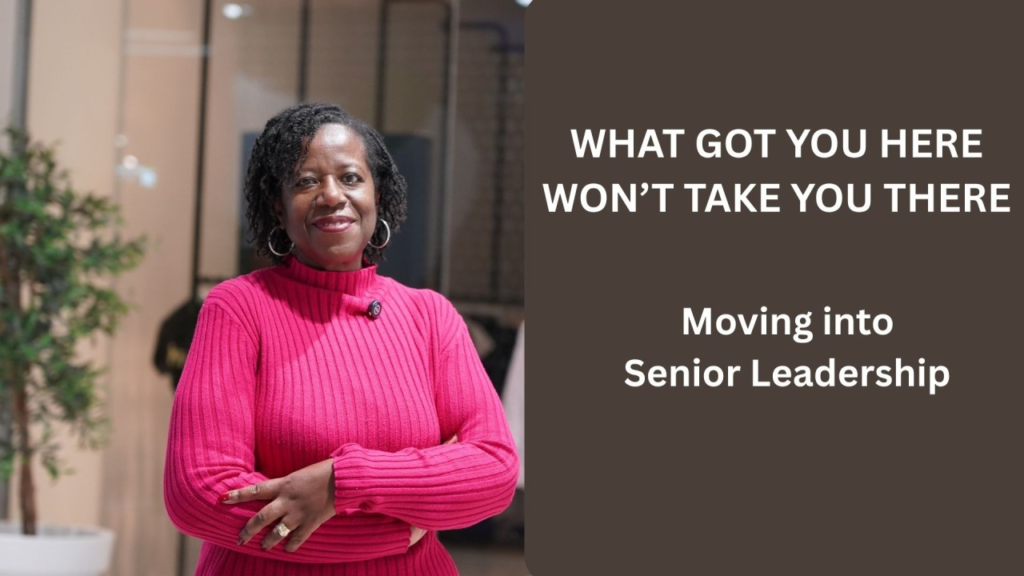
You may have got to where you are as a middle manager based on your knowledge and expertise of the role, but that alone won’t get you to senior or executive leadership.
The skills that helped you build credibility at one level can sometimes hold you back at the next. Moving into senior or executive leadership requires more than greater responsibility. It requires a different skillset and a fundamental shift in how you think, influence and lead.
I often coach leaders who were promoted because they were the recognised expert in their area. Yet once they stepped into senior leadership, they struggled because they continued solving every problem themselves rather than enabling others to do so.
You need to move from thinking primarily about ensuring day-to-day operations run effectively, to considering the bigger picture. That includes understanding the wider PESTLE factors – political, economic, societal, technological, legal and environmental – and what they mean for your organisation.
It’s not just about how you lead your teams. It’s also about understanding your role in the wider organisation and how what you do contributes to bigger outcomes.
For many of the leaders I coach, this transition can feel overwhelming. Particularly when the very things that have made them successful so far are the things they have come to rely on.
So, what needs to change?
1. Shift from operational thinking to strategic thinking
At middle management level, much of your focus may have been on delivery. Are things getting done? Are targets being met? Are problems being resolved?
Those things don't suddenly become unimportant when you become more senior. But you can't stay immersed in them in the same way. You need to start looking further ahead (whilst ensuring that your direct reports are running day to day operations effectively).
What is happening outside the organisation that could affect it? What might be coming down the line in six months, two years or five years? What opportunities might you be missing? What risks need to be anticipated rather than dealt with once they become problems?
And importantly, what does all of this mean for the decisions you are making today?
Strategic thinking isn't just something you do at an annual strategy day. It becomes part of how you think.
2. Stop feeling that you need to have all the answers
Your expertise may have been one of the things that got you promoted.
People came to you because you knew what to do. You solved problems. You were reliable. You got things done.
The problem is that this can make it difficult to let go.
At a more senior level, your value isn't determined by how much you personally know or do. You will increasingly be leading people who know far more about their specialist areas than you do.
Your role becomes one of asking good questions, creating the conditions for other people to do their best thinking and making sound decisions when you don't have all the information you would ideally like.
That can feel uncomfortable, particularly if being knowledgeable and competent has become an important part of how you see yourself as a leader.
3. Think beyond your own area
One of the biggest shifts is moving from my team, my department, my objectives to our organisation.
There will be times when what is best for your function isn't necessarily what is best for the organisation as a whole. Senior leadership requires you to understand those competing priorities and make decisions accordingly.
It also means understanding what matters to other parts of the organisation. What pressures are they facing? What are they trying to achieve? Where does your work intersect with theirs?
The more senior you become, the less effective you can be operating in a silo.
4. Recognise that influence becomes increasingly important
You may have direct authority over the people who report to you, but many of the people you need to influence at senior level won't report to you at all. They may be your peers, other senior leaders, board members, external stakeholders or people with considerably more positional power than you have.
This requires a different set of skills.
You need to understand different perspectives, communicate your thinking clearly, build relationships before you need them and become comfortable challenging and being challenged. For some leaders, particularly those who dislike organisational politics or self-promotion, this can feel uncomfortable.
But influence doesn't have to mean becoming political, performative or the loudest person in the room.
It is about understanding how decisions get made and how you can contribute effectively to them.
5. Your leadership identity needs to catch up with your role
This is one I see frequently in my coaching. Someone gets promoted, but internally they still see themselves as the person they were before the promotion.
They question whether they really belong at that level. They compare themselves with people who appear more confident or experienced. They hesitate to speak because they think everyone else knows more than they do.
Sometimes they retreat to what feels safe: getting involved in the detail, doing work that should be delegated or relying heavily on their technical expertise. But at some point, you have to give yourself permission to occupy the role you have stepped into.
That doesn't mean pretending to know things you don't know or suddenly becoming supremely confident. It means recognising that you are there to contribute.
Start before you get the promotion
If you aspire to senior or executive leadership, don't wait until you get there to start making these shifts. Look for opportunities now to broaden your perspective.
Spend more time understanding what is happening across your organisation, not just within your own area. Pay attention to the external factors affecting your sector. Build relationships outside your immediate function. Ask more strategic questions in meetings. Notice when you are getting pulled unnecessarily into operational detail.
Because progressing into senior leadership isn't simply about doing more of what made you successful before. Sometimes it requires you to let go of some of it.
Which habits or skills that helped you succeed so far might be preventing you from succeeding at the next level?