
I've watched people's faces when I tell them this.
There's a pause. A slight tilt of the head. The kind of look that says "are you sure you know what introvert means?"
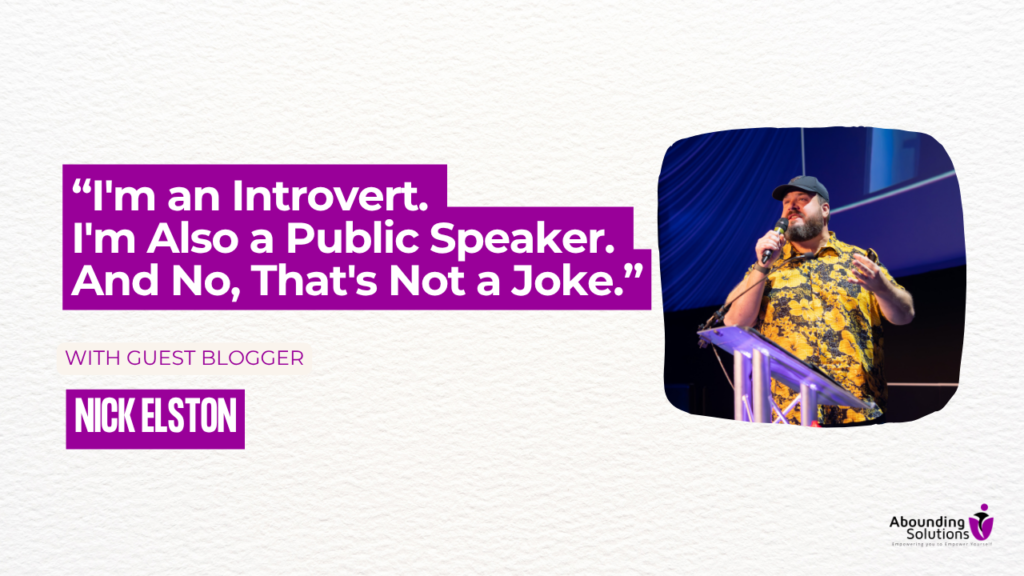
And I get it. I do. Because the version of me that walks into a room full of people, takes a microphone, and talks about the messiest, most human parts of life for an hour doesn't exactly scream "needs alone time to function."
But here's the thing. That's exactly what I need.
Let me clear something up, because it took me a long time to understand this myself.
Introversion is not shyness. It's not social anxiety. It's not a fear of people, a hatred of small talk, or a personality disorder that means you sit in the corner at parties eating sausage rolls and avoiding eye contact.
It's about energy.
Specifically, it's about where you get yours from and where it goes.
Extraverts recharge around people. They light up in a crowd, they feed off the energy in the room, they come home from a big social event buzzing. They're the people who finish a long day of back-to-back meetings and suggest going for drinks. More people. Yes please.
That's genuinely not me.
I come home from a full day of speaking, training, coaching, being fully and completely present with a room full of humans, and I need to disappear. Quietly. Without fanfare.
Not because I didn't enjoy it. Not because the room was bad or the people were hard. Often the complete opposite.
But because I gave everything. And I mean everything.
And I need to go and get it back.
Here's what my version of recharging looks like.
It's quiet. It's deliberate. It's usually just me, a coffee I've made at home, and something completely unrelated to work. A walk on my own. Music that nobody else has chosen. A film I've watched three times already because I know exactly what's going to happen and there are no surprises.
No performance. No presence. No being on.
Just me, in my own company, slowly filling back up.
And I protect that time with a ferocity that probably surprises people who've only seen me on a stage.
I've had to learn to. Because for a long time I didn't. I said yes to everything after everything. The post-event drinks. The extra session. The "while you're here, could you just..." I convinced myself that being available was the same as being professional. That saying no was the same as being difficult.
What it actually was, was me emptying a tank I never gave myself permission to refill.
The irony of being an introverted speaker isn't lost on me.
I have chosen a career that requires me to walk into rooms full of strangers, make them feel safe enough to talk about the things they usually don't, hold the energy of a whole group for an hour or more, and then come out the other side having hopefully left something useful behind.
That is not a small ask of a person who recharges alone.
But here's what I've come to understand. The introversion and the speaking don't conflict. They actually explain each other.
Because I've spent a lifetime watching. Listening. Processing. Being the person in the room who's quietly taking everything in rather than being the loudest voice in it. That's not a weakness. That's everything.
The empathy. The attention to what's not being said. The ability to read a room before I've opened my mouth. The patience to sit in silence with someone who's struggling instead of rushing to fill the gap with noise.
All of that? Introvert behaviour.
All of that? Also the thing that makes the work work.
I remember a conversation with someone after a session. One of those quick chats at the side of the room while everyone else is packing up and reaching for their phones.
She said: "You seem so comfortable up there. I'd never have guessed you were an introvert."
And I thought about it for a second.
Because I am comfortable up there. Genuinely. There's something about having a clear purpose in a room, a reason to be present, a direction to face, a conversation worth having, that suits me. I'm not uncomfortable with people. I'm not afraid of being seen.
I'm just very, very clear on what it costs me.
And equally clear on what it's worth.
The discomfort isn't the room. It's everything around the room. The networking beforehand. The lingering after. The small talk in the lift. The "so what do you do?" conversations over warm white wine.
Give me a stage and a topic I care about and I will show up fully, completely, without reservation.
Give me a networking event and a name badge and I will find the dog, or the kitchen, or the one other introvert in the corner who also looks like they're calculating the minimum socially acceptable amount of time before they can leave.
There's a version of this story where I felt broken for a long time.
Where I thought something was wrong with me because I didn't want to go to the after-party. Because I needed to sit in my car for ten minutes after a big session before I was ready to drive home. Because I sometimes turned down opportunities that looked great on paper but felt, instinctively, like they'd take more than they'd give.
I thought that meant I wasn't cut out for this.
What I know now is that it meant I was paying attention.
Every person in that room deserves a version of me that has something left to give. That's not possible if I'm running on empty. Protecting my energy isn't a luxury. It's the job.
So if you're an introvert, and there are more of you reading this than you think, because we're quiet about it, I want you to hear this.
You don't need to become an extravert to do the thing.
Whatever the thing is. Speaking. Leading. Performing. Putting yourself out there in ways that terrify you a little bit.
You just need to understand how you work.
Know what fills you up. Know what empties you. And protect the former with the same energy you give to everything else.
The world will always ask for more of you. That's not personal. That's just the world.
But you get to decide what you give, and what you keep.
And what you keep? That's what makes everything else possible.
The coffee's getting cold.
I've got twenty minutes before my next call.
And I'm going to spend them exactly the way I want to.
Quietly. On my own. Filling back up.
See you on the other side.
About Nick Elston
 Nick Elston is an award-winning mental health keynote speaker, transformational speaking coach and founder of Forging People. Drawing from his own lived experience of anxiety, OCD and burnout, Nick specialises in helping individuals and organisations have more honest, human conversations around mental health, resilience and communication. Trusted by global brands and known for reaching the people other speakers can't, Nick works across corporate, education and reform sectors with warmth, credibility and zero jargon. He also coaches and develops speakers through Forging People, helping others find their voice and build platforms of their own. Human first. Always.
Connect with Nick